

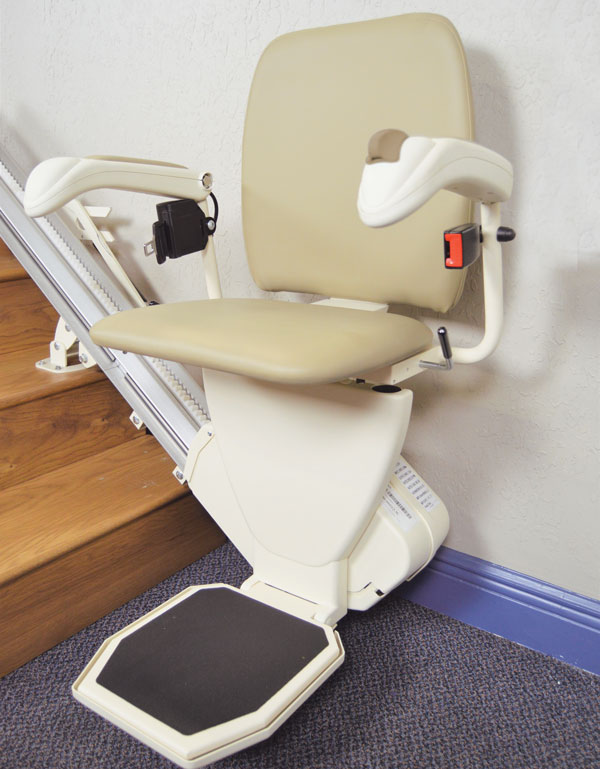
Massachusetts has some of the oldest housing in the country, and three house types account for a great many of the staircases we see. Each one asks something different of a stair lift.
The triple-decker
A triple-decker has a long, straight interior stair to each upper unit, often steep and enclosed between two walls. A straight stair lift suits it well. The compact Indy Pinnacle folds to 11 inches from the wall, which leaves room for other tenants and for carrying groceries past it. Where a stair serves more than one household, talk to the owner and to us about what is allowed.
The center-hall colonial
The classic colonial has a straight stair rising from the front hall, in full view of the door. Appearance matters here. The rail is fixed to the treads, not the wall or the balusters, so the woodwork is untouched, and the chair can be parked at the top of the stairs where visitors do not see it. If the front door is close to the bottom step, a folding rail keeps the doorway clear.
The Cape
A Cape often has a steep, narrow stair tucked between the rooms, leading to bedrooms under the roof. Headroom at the top can be tight. We measure the clearance carefully and check that the rider can step off safely onto the upper floor.
Stairs with a turn
Many older houses have a landing or a turn partway up. That calls for either two straight lifts or a rail made to follow the bend. We will tell you which is practical after a look at the stairs.
When a stair lift is not the answer
A stair lift is for someone who can sit and transfer safely. If a wheelchair needs to travel between floors, a home elevator is the better choice.
Nationwide Lifts of Massachusetts is based in Wilmington, MA, with a second office in Raymond, NH. Call (978) 218-7161 or request a free quote.